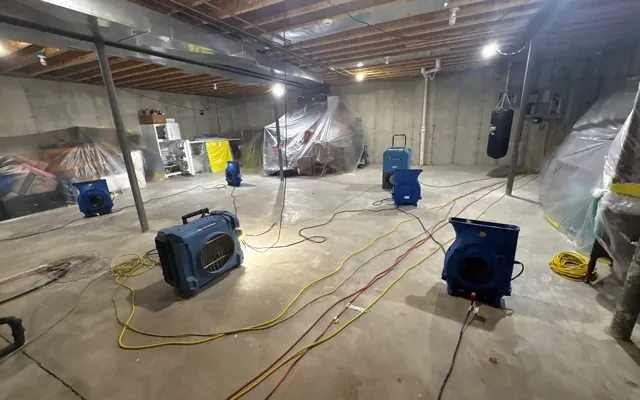
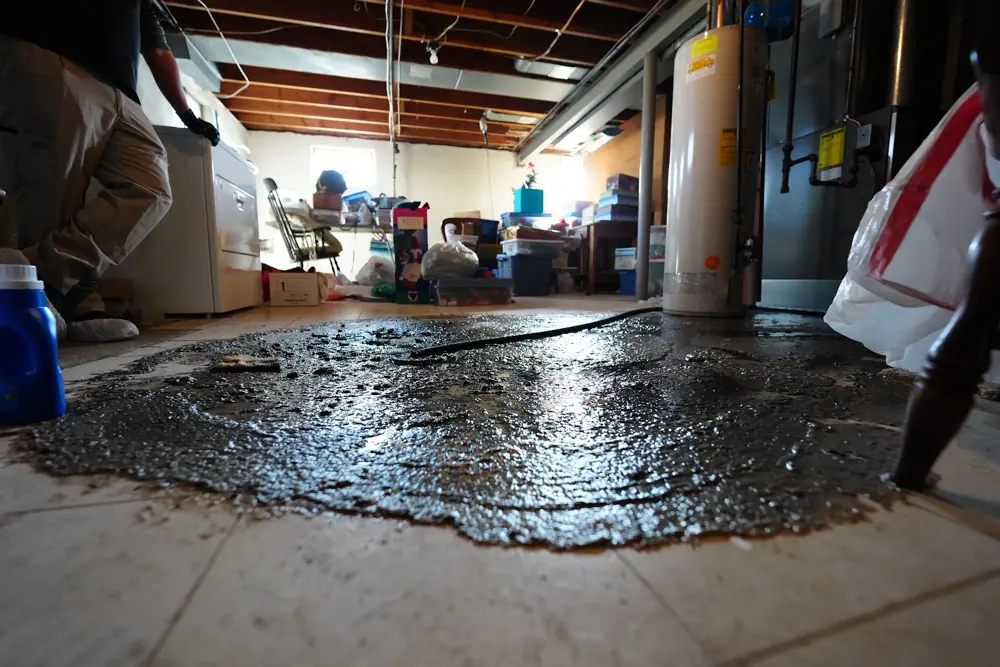
Full basements are the norm across the Salt Lake Valley, and spring snowmelt, a high water table, and sump pump failures push water into them fast. Crews arrive quickly with IICRC-standard extraction and structural drying.

Truck mounted and portable pumps clear standing water while technicians screen for drain backup contamination, check the foundation, and identify what can be saved.
Industrial air movers and dehumidifiers target foundation walls, subfloor, and framing, with daily moisture readings guiding the drying plan toward dry standard.
Saturated carpet pad, drywall, and insulation are cut out and disposed of, and structural surfaces are cleaned and treated where contamination is a concern.
Crews restore drywall, flooring, and trim once dry, and can recommend a sump pump with battery backup or improved drainage to prevent a repeat.

While help is on the way, these first steps, done only where it is safe, limit the damage and protect the insurance claim.
Shut the supply off at the source, or close the home's main valve if the source is not obvious. Stopping the flow limits the damage more than anything else.
Switch off electricity to the affected area, but only if the breaker can be reached without standing in or touching the water.
Get a crew dispatched right away. The sooner extraction and drying begin, the more flooring, drywall, and belongings can be saved.
Take photos and a short video of the water and the affected rooms before anything is moved, so the insurance claim starts strong.
Basement flood cleanup in Salt Lake City usually runs $2,000 to $8,500, depending on water volume, how long it stood, and whether the water was clean groundwater or a contaminated backup. Snowmelt seepage jobs often need drainage work alongside the drying. Insurance commonly covers sudden causes like sump pump failure or a burst line, and crews document moisture readings and photos for the adjuster.
Crews reach Salt Lake City and the surrounding valley fast, from Sugar House, The Avenues, and Capitol Hill to Millcreek, Murray, Holladay, West Valley City, and Sandy. See the full list on the areas served across Salt Lake City page.
See all areas servedEvery loss is photographed, measured, and logged from the first visit, so the paperwork holds up with the insurance carrier.
Technicians follow recognized IICRC drying standards and prove it with daily moisture readings on Salt Lake City homes, not guesswork.
Emergency dispatch any hour of the day or night, with a real crew on the way across the valley, not a callback in the morning.
A real crew dispatched any hour, not a callback in the morning.
Trained technicians following recognized IICRC drying standards.
Truck-mounted, portable, and submersible for any size loss.
The loss is documented and billed to the carrier directly.
Crews aim to arrive quickly after your call across Salt Lake City and the surrounding valley. Fast extraction limits how far water wicks into drywall, framing, and belongings, which keeps both the damage and the eventual repair cost lower.
Not always. Clean snowmelt or groundwater seepage is different from a floor drain or sewer backup, which carries health risk. Technicians assess the source on arrival and handle disinfection and safe disposal whenever contamination is involved.
It depends on the cause. Sudden events like sump pump failure or a burst supply line are usually covered, while gradual seepage from grading may not be. Crews document the cause and moisture readings clearly to support the claim either way.
In the Salt Lake Valley, where spring melt and a high water table are common, a sump pump with battery backup is strong protection. Crews can recommend a properly sized system after a flood, installed by a qualified contractor.
Most basements dry in four to eight days depending on how much water intruded and how porous the foundation and finishes are. Crews track moisture daily and keep equipment running until readings confirm the space has reached dry standard.
Salt Lake City crews are on call 24 hours a day, local and fast, and can be on the way within the hour.
Call (801) 405-4247