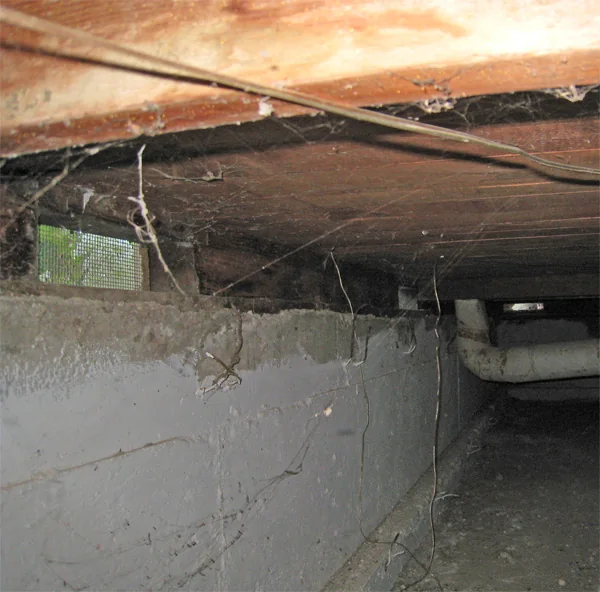
Standing water in a Salt Lake City crawlspace feeds mold and rots the framing above it. Crews pump out the water and dry the space to IICRC-standard, protecting the floor and air quality of the home.

Technicians enter the crawlspace, pump out standing water, and remove saturated insulation and debris that trap moisture against the framing above.
Air movers and dehumidifiers lower the humidity and dry the joists, subfloor, and soil surface, with moisture readings guiding the effort toward dry standard.
Crews clean the space, address any contamination, and treat surfaces where mold growth has begun so the framing is stable before closing up.
Technicians can recommend a vapor barrier, drainage, or a sump to keep the crawlspace dry, coordinated with a qualified contractor.

While help is on the way, these first steps, done only where it is safe, limit the damage and protect the insurance claim.
Shut the supply off at the source, or close the home's main valve if the source is not obvious. Stopping the flow limits the damage more than anything else.
Switch off electricity to the affected area, but only if the breaker can be reached without standing in or touching the water.
Get a crew dispatched right away. The sooner extraction and drying begin, the more flooring, drywall, and belongings can be saved.
Take photos and a short video of the water and the affected rooms before anything is moved, so the insurance claim starts strong.
Crawlspace water removal in Salt Lake City generally runs $1,200 to $6,000, depending on how much water is standing, how long it sat, and whether insulation and the vapor barrier must be replaced. A space with early mold growth or rotted framing costs more. Crews document moisture readings and photos so a sudden covered event is clearly recorded for the carrier.
Crews reach Salt Lake City and the surrounding valley fast, from Sugar House, The Avenues, and Capitol Hill to Millcreek, Murray, Holladay, West Valley City, and Sandy. See the full list on the areas served across Salt Lake City page.
See all areas servedEvery loss is photographed, measured, and logged from the first visit, so the paperwork holds up with the insurance carrier.
Technicians follow recognized IICRC drying standards and prove it with daily moisture readings on Salt Lake City homes, not guesswork.
Emergency dispatch any hour of the day or night, with a real crew on the way across the valley, not a callback in the morning.
A real crew dispatched any hour, not a callback in the morning.
Trained technicians following recognized IICRC drying standards.
Truck-mounted, portable, and submersible for any size loss.
The loss is documented and billed to the carrier directly.
Because it does not drain and no one sees it. A small amount of standing water raises humidity in the closed space, rots the joists and subfloor above it, and grows mold whose spores rise into the home. Removing it early prevents far larger structural and air quality problems.
Crews use low profile pumps and compact air movers and dehumidifiers sized for tight crawlspaces, along with moisture meters on the joists and subfloor. The equipment runs until readings confirm the framing and surfaces have reached a documented dry standard.
Usually yes. Fiberglass batts hanging between the joists soak up water, lose their value, and hold moisture against the wood. Crews remove the saturated insulation so the framing can dry, and it is reinstalled after the space reaches dry standard.
A sealed vapor barrier, good drainage around the foundation, and in some cases a crawlspace sump keep water out. Crews point out the weak spots after drying so a qualified contractor can add the right protection for the home.
Salt Lake City crews are on call 24 hours a day, local and fast, and can be on the way within the hour.
Call (801) 405-4247