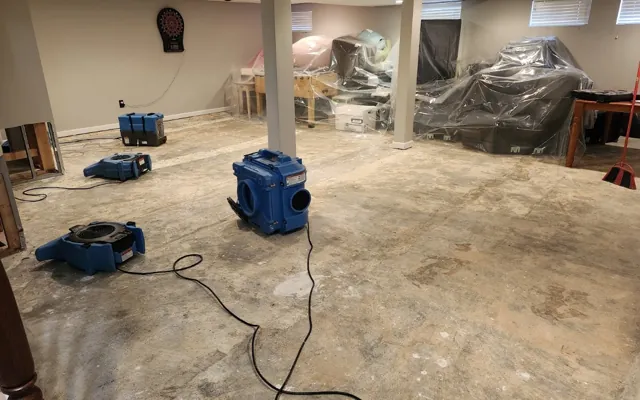
When a sump pump quits during Salt Lake City snowmelt, a basement can flood within hours. Crews respond fast with IICRC-standard extraction and structural drying to save finishes and belongings.

Technicians extract the standing water fast with pumps and extractors, check whether the incoming water is clean or contaminated, and identify what can be saved.
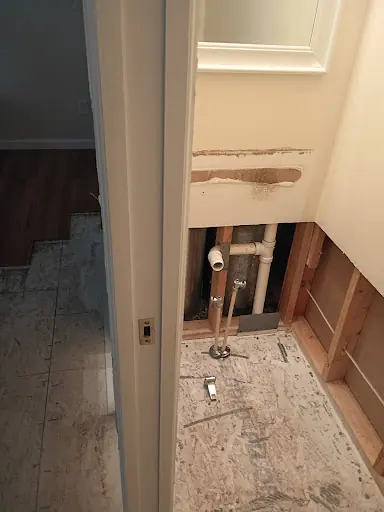
Crews remove saturated carpet pad, lower drywall, and insulation that cannot be dried, and assess the framing and slab for the drying plan.
Air movers and dehumidifiers dry the walls, subfloor, and slab, with daily moisture readings guiding the basement toward a documented dry standard.
Once dry, crews restore finishes and can recommend a new pump with battery backup or a secondary pump so a repeat failure does not flood the space.

While help is on the way, these first steps, done only where it is safe, limit the damage and protect the insurance claim.
Shut the supply off at the source, or close the home's main valve if the source is not obvious. Stopping the flow limits the damage more than anything else.
Switch off electricity to the affected area, but only if the breaker can be reached without standing in or touching the water.
Get a crew dispatched right away. The sooner extraction and drying begin, the more flooring, drywall, and belongings can be saved.
Take photos and a short video of the water and the affected rooms before anything is moved, so the insurance claim starts strong.
Sump pump failure cleanup in Salt Lake City typically runs $2,000 to $8,000, depending on how much water rose before it was caught, how long it sat, and how much finished space was soaked. A quickly caught failure costs far less than one that flooded overnight. Insurance often covers a sudden pump failure, and crews document the source and moisture readings for the adjuster.
Crews reach Salt Lake City and the surrounding valley fast, from Sugar House, The Avenues, and Capitol Hill to Millcreek, Murray, Holladay, West Valley City, and Sandy. See the full list on the areas served across Salt Lake City page.
See all areas servedEvery loss is photographed, measured, and logged from the first visit, so the paperwork holds up with the insurance carrier.
Technicians follow recognized IICRC drying standards and prove it with daily moisture readings on Salt Lake City homes, not guesswork.
Emergency dispatch any hour of the day or night, with a real crew on the way across the valley, not a callback in the morning.
A real crew dispatched any hour, not a callback in the morning.
Trained technicians following recognized IICRC drying standards.
Truck-mounted, portable, and submersible for any size loss.
The loss is documented and billed to the carrier directly.
Because that is when it works hardest. Spring melt and heavy runoff make the pump cycle constantly, which is exactly when a worn pump burns out, a single pump gets overwhelmed, or a storm outage kills a pump with no backup. High demand and failure tend to arrive together.
Quickly. During a saturated melt, groundwater can rise through the pit and put several inches of water across a finished basement within hours. That is why fast extraction matters, and why a battery backup or secondary pump is such valuable protection here.
In the Salt Lake Valley, where melt and a high water table drive heavy pump demand, a battery backup or a secondary pump is strong protection against outages and failures. Crews can recommend a properly sized system for your pit, installed by a qualified contractor.
A sudden mechanical failure is often covered, though some policies require a specific sump overflow endorsement. Crews document the cause and moisture readings clearly so you have the evidence needed to work through your coverage with the carrier.
Salt Lake City crews are on call 24 hours a day, local and fast, and can be on the way within the hour.
Call (801) 405-4247